Posts

New Release
Religion Unburdened by Belief:
The Way of Open Inquiry
Available Now
Get the Book →

Blog

This is where I post short articles about things that I discover.

Subscribe to updates: RSS


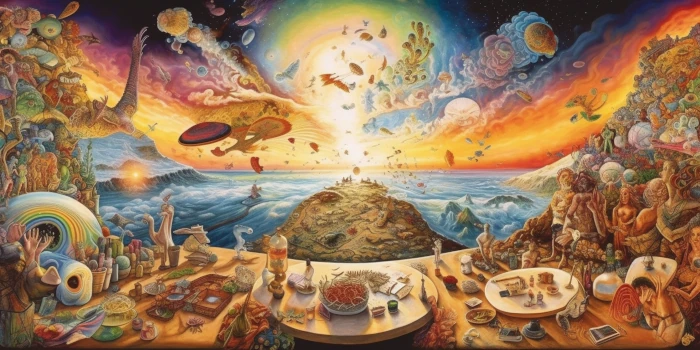
Road ahead
Credit: Midjourney


Mathematical Modeling of the Human Psychedelic Experience

Noonautics and the Trace Institute announced a research collaboration to build a mathematical framework for the human DMT experience. Noonautics, led by neurobiologist Dr. Andrew Gallimore, will use the extended state DMTx protocol, developed with Dr. Rick Strassman, to extend DMT experiences from minutes to hours so trained observers can make sustained observations from inside the state. The Trace Institute, led by Professor Emeritus Donald Hoffman, will apply trace logic and conscious realism, an observer-centered model of reality, to give the resulting phenomenology a quantitative structure.

...

Comment on the proposed 7-hydroxymitragynine (7-OH) scheduling threshold

I commented on HHS-OASH-2026-0232-0001, the Request for Information regarding the proposed 7-hydroxymitragynine (7-OH) scheduling threshold.

Comment Tracking Number: mry-8nrd-tg5g

I am submitting this comment in response to the Request for Information regarding the proposed 7-hydroxymitragynine (7-OH) scheduling threshold (Docket HHS-OASH-2026-0232).

First, on the imminent-hazard finding itself: temporary scheduling under 21 U.S.C. 811(h)(1) is meant to address genuinely urgent threats that cannot wait for ordinary scheduling procedure. I would ask OASH to specify the comparative risk data—overdose rate, dependence liability, and ER visits per capita of users—that establishes 7-OH at the proposed threshold as more hazardous than legal, widely available substances such as alcohol, which carries well-documented acute toxicity and tens of thousands of attributable deaths annually without triggering emergency scheduling. Absent that comparative showing, it is difficult to evaluate whether the proposed threshold reflects an evidentiary emergency finding or a policy preference.

...

My Child Only Cares About Their Own Feelings. Is This Normal?

Is it normal for a young child to not want to share anything—toys, food, outerwear? #

Yes, completely normal. Young children are egocentric by design. Their brains are still developing the capacity for perspective-taking, impulse control, and emotional regulation. True perspective-taking doesn’t emerge until around ages four to six. Children may eventually outgrow selfishness, but waiting for that to happen is a missed opportunity. The brain is also highly plastic at this age. Parents have enormous power to foster generosity, and the earlier they start, the better.

...

The Hiccups Strike Again

Got home from a Santo Daime work tonight. Then I drank some water. Carelessly. The way a person does who has forgotten that the universe enjoys irony.

Hic.

You’d think I’d have learned to sip like a Victorian lady at high tea by now. Instead, I apparently chug like I’m trying to win a contest. The hiccups arrived right on schedule to collect their tribute.

I tried sugar, the classic remedy. Hic.

...

Cannabis for Sexual Pleasure

Most cannabis formulations, built around just THC and CBD, can work for intimacy—but they require a certain amount of mental effort to stay in a good headspace. That’s the kind of effort you don’t need to be making.

Relax Blend #

Adding a third cannabinoid—CBN (cannabinol)—to the THC+CBD combination creates something noticeably more stable. In a 1:1:1 ratio of Δ9-THC, CBD, and CBN, the experience is self-regulating. You don’t need to steer your mood. The blend handles that, freeing your attention for your partner, your body, and the moment.

...

Why the Honesty Token Misses the Point

The Viral Moment #

A parent hands their child an apple-shaped token. The deal: bring me this token and you can tell me anything—no punishment, no consequences. The video spread because it feels like a breakthrough. Parents watching think, why didn’t I think of that?

It’s an ill-conceived strategy.

Why Children Hide Things #

Internal Family Systems (IFS) therapy holds that the mind is made up of parts with distinct roles. When a child hides something, a part is at work whose job is to keep the secret—call it Keeper. Keeper fears the parent’s reaction: anger, punishment, shame, withdrawal of love. That fear may be justified by past experience or purely anticipatory. Either way, Keeper concluded that honesty with this parent is too risky.

...

Psilomethoxin, My Case Report (Addendum #3)

I recently tried 5-MAPB (5-(2-methylaminopropyl)benzofuran) at 80mg on a single occasion—my first experience with an MDMA-like compound. This gave me a useful point of comparison with psilomethoxin (Pm).

In my judgment, Pm at 0.5–1g most closely resembles 5-MAPB. Below that range, Pm is too subtle; above it, the experience pulls inward too firmly in a way that diverges from the 5-MAPB character.

The comparison confirmed differences I had suspected. 5-MAPB is a stimulant—sleep on the day of administration was a challenge. Pm is not a stimulant; as noted in the original case report, falling asleep at the peak is possible.

...

Full Control Over Footnote Placement for memoir

This is a follow-up to LuaLaTeX Footnote Maze, which documented the long road to making memoir paragraph footnotes work inside breakable tcolorbox environments with hyperref. That solved half the problem. This post solves the rest of the problem: deciding exactly where on the page footnotes appear.

Downloads: memoir-fnqueue.sty · memoir-tcolorbox.sty · test-fn.tex · test-fn.py

The Remaining Gap #

After the earlier work, footnotes escaped their tcolorbox prisons and rendered as proper paragraph footnotes with working hyperref links. But placement was still automatic—footnotes released at the end of a box landed wherever TeX’s page builder decided, sometimes colliding with other content when the combined height of sidebar plus footnotes barely exceeded the page.

...

Balance of Power

Balance of Power #

Abstract #

This is my remix of Vitalik’s Dec 30 essay of the same title.

Modern civilization depends on powerful institutions—corporations, governments, and mass movements—to drive progress, yet these same forces threaten freedom and flourishing as they concentrate power. This essay examines how Big Business, Big Government, and Big Mob each become dangerous through specific mechanisms: corporations through profit optimization that diverges from social welfare and through homogenization driven by scale; governments when they shift from neutral frameworks to active agents pursuing their own agendas; civil society when diverse institutions collapse into unified mobs.

...

Boredom

A digital illustration of a young woman with long, wavy brown hair. She rests her chin on her fist, her expression conveying boredom or mild annoyance. She wears a pink tank top. The style is semi-realistic with soft brushwork.


boredom