
Posts

New Release
Religion Unburdened by Belief:
The Way of Open Inquiry
Available Now
Get the Book →

Blog

This is where I post short articles about things that I discover.

Subscribe to updates: RSS


Road ahead
Credit: Midjourney


The Kykeon Cold Case

Note: “Hamilton Morris” in this piece is a fictional alias. It is not the real journalist and chemist of that name. It’s a playful stand-in for an anonymous psychonaut who did the work described below. Everything attributed to him here is invented dialogue built around real experimental details shared with me anonymously. Matthew Stahl is a real person, and the recipe discussed is his, adapted from his book LSI.

For roughly two millennia, once a year, thousands of initiates walked from Athens to the sanctuary at Eleusis to drink a beverage called kykeon. Plato likely went. Cicero later wrote that Eleusis gave people “a reason not merely to live in joy, but to die with a better hope.” The Homeric Hymn to Demeter describes the rite in reverent language, but also evasively because the rites were considered sacred and initiates were sworn to secrecy. For nearly two thousand years, the secret remained remarkably well guarded. Finally, outside pressure shut the practice down. Roman Emperor Theodosius I effectively banned pagan worship in 392 CE. A few years later the sanctuary at Eleusis was looted and devastated by invading Goths led by Alaric. The last initiates who knew it firsthand eventually died, and the secret was lost.

...
Incorruptible Institutions Need Incorruptible People First

Eric Ries’s new book Incorruptible: Why Good Companies Go Bad… and How Great Companies Stay Great names a question that haunts anyone who’s built a business they care about: whether their creation can survive the forces of success. He calls that pressure financial gravity: the doctrine of shareholder primacy pulling every company toward extraction. Ries’s answer is structural. Costco’s governance. Patagonia’s ownership handed to the earth. GitLab’s values embedded so deeply in process that no one has to be in the room to enforce them. Build the right scaffolding, he argues, and the mission survives contact with success.

...

Review of *Psychedelic Medicine & IFS Therapy: A Clinical Skills Manual*

Reading Between the Parts #

“Psychedelic Medicine and Internal Family Systems (IFS) Therapy: A Clinical Skills Manual” (2026) lays out a clinical protocol (IFS-PAT) for integrating Internal Family Systems therapy with psychedelics. The authors walk through the full arc of a course of treatment. The manual is aimed at practicing clinicians rather than a general audience. I’d been eagerly waiting for these authors to put their cards on the table. Now that they have, three things stand out: two sloppy sections, one recurring confusion that runs deeper than either, and a guess about why.

...

A Specimen of Fraternal Correspondence, 1992

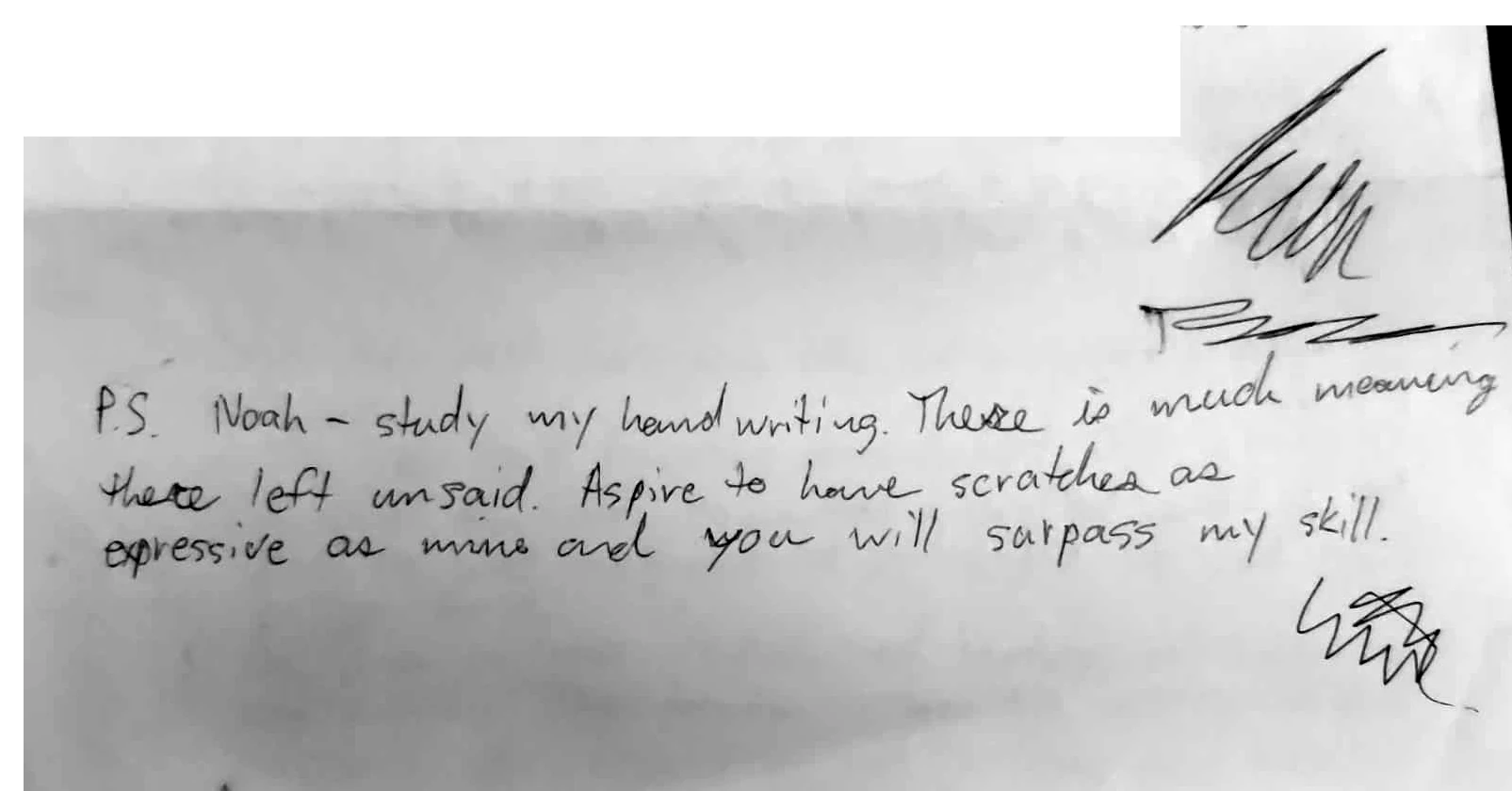
Behold a rare surviving artifact: a postscript, hand-inked, extracted from a letter sent across a distance of state lines by myself, then nineteen years of age, to my younger brother, aged nine. I had departed the family home abruptly in 1990, drawn by the migratory pull to prestigious university education.


letter to brother


“P.S. Noah — study my handwriting. There is much meaning there left unsaid. Aspire to have scratches as expressive as mine and you will surpass my skill.”

...

From Corporate IT to IFS Practitioner: Robert Lilly's Journey

I met Robert when he reached out for an in-person IFS session. At the time, he was on sick leave from employment in corporate IT. He was burned out. Stuck. The income was steady enough that leaving felt irresponsible, but staying felt like it was costing him something he couldn’t yet name.

Robert describes his situation:

I first discovered IFS through an online community focused on nondual teachings, where several members happened to be practitioners. While on medical leave, I realized I needed deep internal work before returning to my career. I started by working through Jay Earley’s Self-Therapy on my own, but while I identified a few protector parts, I couldn’t create true relief alone.

...

Mathematical Modeling of the Human Psychedelic Experience

Noonautics and the Trace Institute announced a research collaboration to build a mathematical framework for the human DMT experience. Noonautics, led by neurobiologist Dr. Andrew Gallimore, will use the extended state DMTx protocol, developed with Dr. Rick Strassman, to extend DMT experiences from minutes to hours so trained observers can make sustained observations from inside the state. The Trace Institute, led by Professor Emeritus Donald Hoffman, will apply trace logic and conscious realism, an observer-centered model of reality, to give the resulting phenomenology a quantitative structure.

...

Comment on the proposed 7-hydroxymitragynine (7-OH) scheduling threshold

I commented on HHS-OASH-2026-0232-0001, the Request for Information regarding the proposed 7-hydroxymitragynine (7-OH) scheduling threshold.

Comment Tracking Number: mry-8nrd-tg5g

I am submitting this comment in response to the Request for Information regarding the proposed 7-hydroxymitragynine (7-OH) scheduling threshold (Docket HHS-OASH-2026-0232).

First, on the imminent-hazard finding itself: temporary scheduling under 21 U.S.C. 811(h)(1) is meant to address genuinely urgent threats that cannot wait for ordinary scheduling procedure. I would ask OASH to specify the comparative risk data—overdose rate, dependence liability, and ER visits per capita of users—that establishes 7-OH at the proposed threshold as more hazardous than legal, widely available substances such as alcohol, which carries well-documented acute toxicity and tens of thousands of attributable deaths annually without triggering emergency scheduling. Absent that comparative showing, it is difficult to evaluate whether the proposed threshold reflects an evidentiary emergency finding or a policy preference.

...

My Child Only Cares About Their Own Feelings. Is This Normal?

Is it normal for a young child to not want to share anything—toys, food, outerwear? #

Yes, completely normal. Young children are egocentric by design. Their brains are still developing the capacity for perspective-taking, impulse control, and emotional regulation. True perspective-taking doesn’t emerge until around ages four to six. Children may eventually outgrow selfishness, but waiting for that to happen is a missed opportunity. The brain is also highly plastic at this age. Parents have enormous power to foster generosity, and the earlier they start, the better.

...

The Hiccups Strike Again

Got home from a Santo Daime work tonight. Then I drank some water. Carelessly. The way a person does who has forgotten that the universe enjoys irony.

Hic.

You’d think I’d have learned to sip like a Victorian lady at high tea by now. Instead, I apparently chug like I’m trying to win a contest. The hiccups arrived right on schedule to collect their tribute.

I tried sugar, the classic remedy. Hic.

...